
By Peter Altobelli, President, Yardi Canada Ltd.
After two years of steady softening, Canada’s multifamily market found some footing in the second quarter of 2026. The national vacancy rate fell 40 basis points to 4.7%, breaking a run of nine straight quarters of increases. Rent growth is still slowing but it hasn’t turned negative overall. Average in-place rent nationally rose to $1,774, up 2.2% year over year, which is the smallest annual gain since late 2021.
The softness shows up most clearly in new leases. Nationally, lease-over-lease rates on units that turned over were -0.6% in the quarter, the second straight quarter in negative territory, though slightly better than the -1.0% seen the quarter before. In other words, the rent lift landlords have relied on at turnover has largely disappeared in many markets, and renewals are now carrying most of the growth. The backdrop is a mixed economy: GDP swung back to positive in April after two negative quarters, the national unemployment rate eased to 6.5% in June, and hiring among 15 to 24 year olds picked up, which tends to feed new rental household formation.
Where Saskatchewan stands apart
Saskatchewan does not move in lockstep with the national story, and that is worth paying attention to. On new leases, the province held up better than the national average this quarter, sitting near the top of the provincial group rather than dragging behind markets like British Columbia and Ontario, where oversupply in the big downtown cores has pushed new lease rates sharply negative.
Saskatoon, the province’s benchmark market in the report, tells a more nuanced story. In-place rents rose 1.4% year over year, positive but below the 2.2% national pace. New lease rates came in at -1.3%, reflecting the same turnover softness showing up across most of the country. Vacancy sat at 5.2%, a touch above the 4.7% national figure. The number that really sets Saskatoon apart is turnover: at 40.4%, it was the highest of any major market in the country, well above the 26.2% national rate. Residents in Saskatoon also stayed the shortest, an average of 24 months versus 38 nationally.
That combination, moderate rents with very high tenant movement, defines the operational reality here. A market where four in ten units turn over every year is a market where leasing performance and how quickly you backfill a vacancy matter enormously to the bottom line.
There is a bright spot in how those prospects are found. Saskatoon converted 10.8% of digital prospects into residents, comfortably above the 8.4% national conversion rate, and drew 22 digital prospects per 100 units each month. Housing providers here are getting real traction from online channels, which matters more in a high-turnover market than almost anywhere else.
The operational reality
High turnover is not just a leasing metric, it is a cost driver. Every move-out means a unit to clean, repair, market and re-lease, and every one of those steps carries expense and downtime. In a market turning over at 40%, small improvements in how smoothly a resident moves in or out compound quickly across a portfolio.
This is where digital communication and self-service tools earn their keep. Online applications, digital lease signing, self-guided or scheduled tours, and streamlined move-in and move-out workflows shorten the gap between one lease ending and the next beginning. Given that Saskatoon renters are already responding to digital channels at an above-average rate, leaning further into those tools is a natural fit rather than a leap.
The takeaway holds regardless: meeting renters where they already are, online, is now table stakes for keeping units filled.
The cost equation: operating metrics to watch
Rent is only one side of the ledger. The report tracks three expense measures per unit that every housing provider should be watching as they plan:
Repairs and maintenance per unit captures the recurring cost of keeping units and common areas functional, from appliance and electrical repairs to unit turnover, landscaping and cleaning. In a high-turnover market, this line is especially sensitive to how often units change hands.
Controllable expense per unit covers the operating costs a manager can influence, including administration, payroll, repairs and maintenance, utilities, marketing and management fees.
Total expense per unit adds the items largely outside a manager’s control, such as property taxes and insurance, on top of controllable costs. Nationally this ran $8,165 per unit in the quarter, with Alberta at $8,127 and Ontario highest at $8,978. Tracking your own numbers against these benchmarks is a quick way to spot where your portfolio is running hot.
What this means for Saskatchewan housing providers
The data points to a clear planning priority: manage for turnover. With residency the shortest and turnover the highest of any major market, the operators who do best in Saskatchewan will be the ones who treat every vacancy as a process to optimize rather than an event to react to.
A few report KPIs are worth building into your 2026 planning. Watch turnover percentage and average length of stay together as your retention scorecard, since improving even one of them takes real cost out of the system. Track digital prospect conversion, because Saskatoon’s above-average numbers show the demand is there to capture. And benchmark your repairs, controllable and total expense per unit against the provincial and national figures to see where you have room to tighten. Used together, these numbers move you from reacting quarter to quarter toward planning with intent.
For the full national and market-by-market data behind these trends, the latest Yardi Canadian National Multifamily Report is available here.
The Blind Discount – The Data Gap Behind Rent and Concession Decisions
The most common response to slower lease-up is to reduce asking rents or introduce additional incentives. These strategies can be highly effective, but only when pricing is the true constraint. In many cases, however, leasing performance is being limited by operational execution, including slow response times, inconsistent follow-up, weak prospect qualification, or poor closing performance.
This report explores why pricing decisions should be grounded in data rather than assumptions and provides a practical framework for identifying the underlying constraint and determining which leasing lever should be addressed first.
The Saskatoon Chamber has written to provincial policymakers urging them to consider the unintended consequences of rent control policy that consistently fails to improve affordability and harms new renters and new investment alike. Housing affordability is a pressing issue for many, and we share the goal of ensuring that safe, quality rental housing is accessible and attainable. However, we strongly caution against rent control as the means to that end. The evidence is clear and consistent: rent control, while well-intentioned, produces outcomes that are fundamentally at odds with long-term affordability and housing supply.
Read our letter here.
You can read he letter from the Saskatoon Chamber of Commerce below:
Proposed Rent Control Policy – Concerns and Constructive Alternatives
Opposition Leader Beck & MLA ChiefCalf, On behalf of our 1,500 member businesses and property owners, I am writing to express our serious concerns regarding the growing discussion around rent control in Saskatchewan. We recognize that housing affordability is a pressing issue for many residents, and we share the goal of ensuring that safe, quality rental housing is accessible and attainable. However, we strongly caution against rent control as the means to that end. The evidence is clear and consistent: rent control, while well-intentioned, produces outcomes that are fundamentally at odds with long-term affordability and housing supply.
Concerns and Unintended Consequences
Development margins for rental housing are already thin. When revenue is capped or made uncertain, fewer projects will meet investment thresholds—particularly at a time when construction costs, property taxes, insurance, and utilities continue to rise. Many multi-family developments today are viable only because of federal programs such as CMHC-backed financing. There is a fundamental contradiction encouraging supply through federal incentives while simultaneously discouraging it through provincial policy.
Specifically, our members are concerned that rent control will:
- Reduce housing supply by discouraging new development and driving capital to other jurisdictions with more predictable regulatory environments.
- Degrade housing quality over me, as constrained revenue forces landlords to defer maintenance, reduce services, and delay reinvestment in aging building stock.
- Encourage market exit and condominium conversions, further shrinking the available rental pool.
- Reverse a generation of progress in Saskatchewan’s rental market, which has evolved over 25 years from a sector serving primarily students and transitional renters into a legitimate, long-term housing choice supported by higher-quality, professionally managed product.
- Introduce policy risk that, even before implementation, can shift investment decisions—capital in real estate is highly sensitive to regulatory uncertainty.
We urge you to consider the well-documented experience across other provinces and countries: rent control consistently fails to improve long-term affordability and routinely produces a two-tiered market that disadvantages new renters and new investment alike.
Targeted, Supply-Focused Solutions
The most durable solution to housing affordability is increased supply. The Greater Saskatoon Chamber of Commerce is committed to working collaboratively with policy-makers to identify and implement policy tools that lower the cost of building and operating rental housing. We respectfully propose the following alternatives:
- Remove PST on new residential construction costs. Saskatchewan is one of the few provinces that applies PST to construction inputs. Eliminating or phasing out this tax would directly reduce development costs and improve project feasibility for new rental supply.
- Introduce property tax relief, incentives, and abatements for purpose-built rental housing. In partnership with municipalities, targeted property tax relief for new and existing rental stock would help offset rising operating costs and support reinvestment.
- Cap assessment spikes on existing rental properties. Saskatoon’s property reassessment swings are disproportionately large compared to other markets, creating sudden cost shocks for rental operators that have real consequences for rents and investment decisions.
The Chamber is open to engaging with your Caucus on these and other evidence-based solutions. We believe that with the right policy framework, Saskatchewan can be a national leader in rental housing supply, quality, and genuine long-term affordability—without the damaging side effects of rent control.
Thank you for your consideration.
Sincerely,
Jason Aebig, CEO
cc. Hon. Terry Jenson, Minister of Social Services, Government of Saskatchewan, Her Worship Mayor Cynthia Block, City of Saskatoon, Landon Field, CEO, Rental Housing Saskatchewan
Landlords tend to focus on a few core warning signs that reliably predict problems down he road. The most serious issues are almost always tied to financial stability and past rental behaviour, not personal circumstances.
- Insufficient income or unstable employment
- Negative landlord references
- Refusing a credit check
- Personal hardships
- Multiple pets
“A tenant’s financial reliability and rental history tell you far more than their personal situation ever will.”
Read more here.


A smooth move-in sets the tone for the entire tenancy. The article highlights seven habits that help landlords build trust early and prevent misunderstandings later.
- Be organized and prepared – have the unit clean, repairs finished, and paperwork ready so tenants feel confident from day one.
- Communicate clearly – explain expectations, rules, and processes upfront to avoid confusion later.
- Offer a warm welcome – small gestures like a welcome note or move-in guide make tenants feel valued.
- Walk through the unit together – document the condition, answer questions, and show how things work.
- Provide essential information – contacts, emergency procedures, garbage schedules, parking rules, and building policies.
- Set boundaries respectfully – be friendly but professional, establishing a tone of mutual respect.
- Stay available during the first weeks – quick responses build trust and show reliability.
“A positive first impression creates the foundation for a respectful, cooperative landlord-tenant relationship.”
Read more here.
How to Screen Tenants Properly
Choosing the right tenant protects your property, your income, and your peace of mind. A clear, consistent screening process helps avoid costly issues and find renters who are reliable and respectful.
1. Pre-Screening
A quick conversation helps you filter out applicants who don’t meet your basic criteria. Ask about move-in dates, income, pets, and whether they’re comfortable with credit and background checks.
2. Check Background and Credit
A background check reveals any past legal issues, while a credit report shows how reliably the applicant manages financial obligations. Look for consistent payments, manageable debt, and overall financial stability.
3. Verify Income and Employment
Request pay stubs, bank statements, or an employment letter. Confirm details using publicly listed contact information to ensure accuracy.
4. Review Rental History
Speaking with previous landlords gives insights into payment habits, property care, and whether the tenant left on good terms. Past behavior is often the best predictor of future behavior.
5. Meet the Tenant
A short in-person or virtual meeting helps you confirm details, assess communication style, and spot any red flags.
“A thorough tenant screening process is the best way to ensure you find a reliable renter who will treat your property with respect.”
To read more, check out the article here.
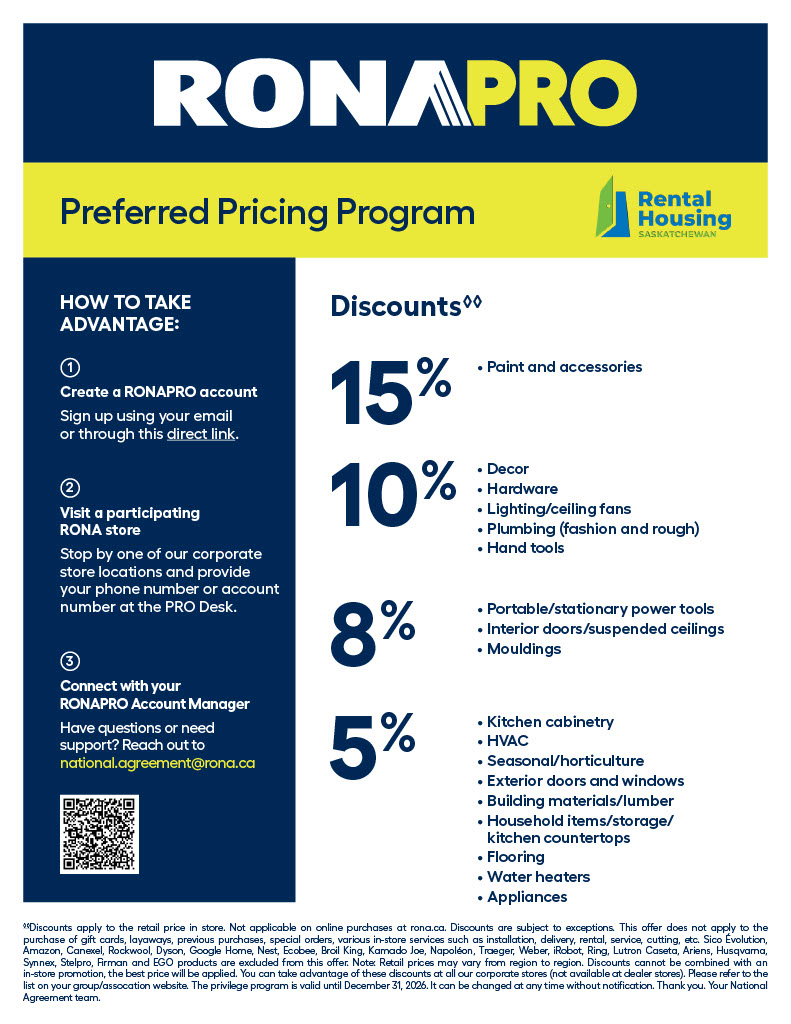
Partner with RONA as an Rental Housing Saskatchewan (SKLA) Member
Everything rental housing providers need — from unit turns to major renovations — backed by RONA expertise and RHSK member benefits. A True One-Stop Solution
RONA offers everything landlords need in one place:
- Access to preferred member-only pricing
- Building materials and renovation essentials
- Flooring, paint, fixtures, and hardware
- Tools and supplies for ongoing maintenance
- Solutions for both small repairs and large-scale projects
Simplified sourcing reduces delays and keeps projects running smoothly.
Expert Support That Works for You
RHSK members benefit from knowledgeable RONA teams who understand volume purchasing and repeat projects. From expert product recommendations to accurate quotes and seamless coordination, RONA helps keep every project moving efficiently and on track.
How RHSK Members Access Exclusive RONA Discounts
Getting started is quick and easy. RHSK members can unlock preferred RONA pricing in just a few simple steps:
- Create a RONAPRO account
Sign up using your email or through this direct link. - Visit a participating RONA store
Stop by one of the locations listed below and provide your phone number or account number at the PRO Desk.
- Connect with Your RONA Account Manager
Have questions or need support? Reach out to Laird Comber at laird.comber@rona.ca or (416) 678-7775.
View the buying guide here!
Participating RONA Locations in Saskatchewan
Regina
3710 Quance St. E
4555 Gordon Road
Saskatoon
1722 Preston Ave. N
125 Betts Ave.
Moose Jaw
769 Thatcher Dr. E
Prince Albert
800 15th St. E

By Peter Altobelli, VP and General Manager, Yardi Canada Ltd.
Canada’s rental market is moving into a slower and more selective phase, according to Q3 2025 findings from Yardi’s Canadian Multifamily Report. Interest rates have started to ease, but operators are still dealing with higher costs, softer job growth and a more mobile renter base. National vacancy is now 4.3 per cent, which is 20 basis points higher than last quarter and 110 basis points higher year over year while in-place rent growth has also slowed to 3.9 per cent across Canada. Annual turnover has climbed to 25 per cent and the average year-over-year stay has shortened to about 36 months, which puts more pressure on leasing and maintenance teams.
Several macro factors are at play. In September, the Bank of Canada cut its policy rate to 2.50 per cent, signalling the start of easing but not a return to the conditions of 2022. At the same time Canada’s effective tariff rate is near 12 per cent with higher costs on steel and aluminum. That has contributed to a 1.6 per cent annualized economic contraction in Q2 and slower job creation. According to Statistics Canada, Canada added only 8,000 jobs per month so far this year, well below the long-term average of 18,000. Population growth also slowed to 47,000 people in Q2, largely because of a 60,000 drop in non-permanent residents. Slower immigration, weaker employment gains and higher operating costs all filter down to owners and managers.
Within that landscape Saskatchewan stands out for its balance. Demand is steady, vacancy is manageable and rent growth is still stronger than the national average.
Saskatchewan’s edge
Saskatchewan’s in-place rent growth is about 4.7 per cent based on two-bedroom units, which puts the province in third place nationally behind Nova Scotia and Quebec. That is a strong result in a year when many markets are adjusting to slower household formation. Vacancy has risen, but it remains low enough to support new inventory without putting housing providers into a discounting cycle.
Saskatoon is the main driver. In place rents in Saskatoon grew 4.7 per cent year over year, which is above the 3.9 per cent national figure. New lease over lease growth is 2.4 per cent. That tells us that renters are still willing to pay more for the right unit even as economic headwinds build. Saskatoon’s vacancy rate is 4.4 per cent. That is slightly higher than the national rate, but it is also one of the more stable readings in the Prairies.
Renter mobility is the one area where Saskatchewan looks more like Alberta. Annual turnover in Saskatoon is 40.7 per cent, the second highest level in Canada after Calgary, which creates more leasing opportunities but also more work for site teams and higher turn costs. That puts added pressure on digital marketing, yet Saskatoon’s digital prospect conversion remains below the national average and has struggled to rise above 9 per cent since 2022. As digital channels continue to gain momentum, housing providers that invest in stronger websites, better listings and smoother enquiry to application workflows will be best positioned to convert interest into leases in this higher mobility market.
Operations: managing mobility
A turnover rate above 40 per cent has real operating implications. Each move out produces a new set of tasks. That can include inspections, minor repairs, cleaning, marketing and screening. If that cycle repeats more often, annual operating costs will rise even when rents are still growing. For that reason retention should be the first lever for Saskatchewan housing providers. Flexible renewal offers, modest rent steps for good tenants and simple move in and move out processes all help reduce churn.
Digital communication is the other lever. With online conversion already at 10 per cent, there is a foundation to build on. Keeping availability, pricing and unit level features current reduces back and forth with prospects. Self service tools for booking tours or submitting documents make it easier for both mobile renters and staff.
Costs to watch
One of Saskatchewan’s advantages is that average monthly operating costs per unit are still lower than the national average and are the lowest among the provinces Yardi tracks in this report. Repairs and maintenance in the province are about 85 dollars per unit per month on average, compared to 147 dollars nationally. Total monthly expenses per unit average 561 dollars in Saskatchewan versus 671 dollars nationally. That gap leaves more room for housing providers to protect margins and reinvest in their strategy, whether that means upgrading buildings, adopting new technology or making day-to-day operations more efficient.
However those line items are still rising faster than rent in some cases. Labour is competitive, especially for skilled maintenance roles. Insurance has been trending higher across Canada. When rent growth slows from 9 per cent to between 3 and 5 per cent, any jump in fixed costs will compress margins. This is where benchmarking becomes important. Comparing your repairs and maintenance, turnover costs and total expenses per unit against provincial averages can show where you are overspending or where processes can be simplified.
What this means for Saskatchewan owners and managers
The data signals a market that is still growing but not at last year’s pace. That calls for a slightly different strategy.
Retention should take priority over aggressive rent increases. Keeping a reliable tenant for another 12 months is often more profitable than pushing rent to the top of the market and risking a vacancy in a city with 40 per cent annual turnover.
Transparency helps convert online interest into signed leases. Publish availability and pricing. Show unit features that matter to renters in this region. Make renewal and service requests easy. Efficiency matters. Track operating metrics like turnover, average length of stay, digital conversion rates and total expenses per unit. Use that information to plan budgets and staffing for 2026.
Finally, stay close to the data. Economic conditions can shift again if tariffs stay high or if immigration slows further. The quarterly Yardi Canadian Multifamily Report provides the national context along with the Saskatchewan level metrics that operators need to make informed decisions.
To see the full set of figures, charts and methodology, visit Yardi’s Canadian multifamily market reports page: www.yardi.com/cndmultifamilyreport
Property Restoration Services for RHSK Members
The following blog was written by RHSK Service Member Lydale Restoration.
Top 5 Summer Risks That Can Lead to Emergency Restoration Calls
Summers often brings sunshine and vacations but it also comes with a set of seasonal risks that can cause serious damage to homes and businesses. We often see a spike in emergency calls during the warmer months. Here are the top five summer hazards to watch out for:
- Wildfires & Smoke Damage
As temperatures rise and conditions become dry, wildfire threats increase, especially in forest-adjacent communities. Even if flames don’t reach your home, smoke and soot can cause significant damage to interior surfaces, HVAC systems, and air quality.
Tip: Create a defensible zone by clearing dry brush, leaves, and debris at least 10 meters from your home.
- Flash Flooding from Summer Storms
Sudden downpours can overwhelm gutters, drains, and municipal systems, leading to flooded basements and property damage.
Tip: Inspect and clean your gutters and downspouts. Consider installing a sump pump with a battery backup system.
- Air Conditioner Leaks or Failures
An overworked or poorly maintained A/C unit can leak water into your walls or ceilings, leading to mold growth and structural issues.
Tip: Schedule an annual A/C inspection and keep drain lines clear to prevent overflow.
- Outdoor Water Usage Gone Wrong
Leaky garden hoses, cracked sprinkler lines, and unattended irrigation systems can cause extensive water damage, especially if water seeps into your foundation or basement.
Tip: Regularly inspect hose connections, turn off water when not in use, and avoid overwatering near your home’s exterior.
- Vacation Mishaps (While You’re Away)
A burst pipe, electrical issue, or unnoticed leak can go undetected for days if you’re away on vacation, leading to extensive damage by the time you return.
Tip: Ask a trusted neighbour to check your home every few days, and consider installing a smart leak or smoke detector that alerts your phone.
While you can’t prevent every emergency, you can take steps to reduce your risk. If the unexpected happens, we are here to help 24/7. Our experienced team is ready to respond fast and restore your home back to normal. Stay Prepared, Stay Protected!.
As a residential rental property manager, you’re responsible for much of the day-to-day operations that keep the facility in good standing and safe for the tenants. While regular property maintenance and minor repairs may be manageable by your in-house staff, more significant issues require a professional team equipped with the right equipment to ensure problems are handled correctly and promptly with as little disruption as possible.
Lydale Property Restoration offers services for property management and rental companies in their time of need for single-family; condo; townhouse; multi-family; and co-op housing properties.
Our services run the gamut of everything from emergency response cleaning and drying after floods, fires, and storms to complete restoration of properties that need updating and renovations.
- Fire and smoke damage restoration;
- Water damage remediation;
- Mould & Asbestos removal and repair;
- Contents restoration;
- Storm damage cleanup;
- Hazard and trauma cleanup and disposal;
- Building restoration.
Your Dedicated Project Manager Has Multi-Unit Restoration Experience
A Project Manager is assigned to every building restoration project, becoming the single point of contact for smooth communication among stakeholders. They’re well-versed in coordinating large projects. Throughout every restoration project they undertake to maintain clear communication with all stakeholders including – condominium managers and councils; rental managers and owners; building managers and concierges; insurance adjusters; insurance brokers; and insurance carriers.
We offer a “time-and-materials” billing arrangement to make it easy for everyone to see exactly what goes into each project. Our team has the experience to accurately estimate the cost of materials and project timelines and can show you employee time summaries and copies of suppliers’ invoices if needed.
Why Lydale Property Restoration?
As a property manager, you need to remedy situations as quickly with as little disruption and inconvenience as possible to building occupants. With a dedicated project manager assigned to your restoration, our crew will work diligently and thoroughly to get your property back to pre-incident condition, and maybe even better. You can be confident choosing us because:
- We have over 45 years of experience in Saskatchewan
- We’re on the list of preferred vendors with most major insurance carriers
- We offer fast and efficient services
- Our team provides the necessary documentation for insurance companies
- We’ll keep you regularly updated with our progress
Saskatoon Office:
859 – 58th Street E
Saskatoon, SK S7K 6X5
Main: 306-934-6116
Fax: 306-934-1119
Regina Office:
1820 Ross Avenue E
Regina, SK S4N 0R9
Main: 306-751-4868
Fax: 306-751-4864